
Did the ancient Egyptians really have secret technology that is now lost?
Since the 1960s, a persistent idea has circulated through popular culture: that the ancient Egyptians possessed advanced technology, now lost to history, which enabled them to construct monuments no civilisation of that era should have been capable of building.
From viral YouTube videos to bestselling pseudoarchaeological books, the notion has convinced millions that the pyramids of Giza require some explanation other than human effort and skill.
The archaeological record, in fact, tells a remarkably detailed and entirely human story about how these feats were accomplished.
Where do the claims come from?
In 1968, Swiss author Erich von Däniken published Chariots of the Gods? Unsolved Mysteries of the Past, a book that proposed extraterrestrial beings had visited Earth in ancient times and helped early civilisations build their most impressive structures.
Selling over 65 million copies worldwide, the book was one of the most commercially successful works of pseudoarchaeology ever written.
Von Däniken argued that the Egyptian pyramids, the Nazca lines in Peru, and other ancient monuments were too impressive for their human builders to have created alone, and that alien intervention was the only plausible explanation.
However, archaeologists and historians rejected his claims almost immediately, pointing out that he misinterpreted artefacts, ignored existing evidence, and applied speculation where documentation already existed.
The idea did not die with von Däniken’s initial popularity, because it found a second life through the Ancient Aliens television series, which first aired on the History Channel in 2010 and ran for over two decades.
Social media platforms such as YouTube and TikTok have further amplified the theory, with content creators producing slickly edited videos that present finely cut stone and mysterious artefacts as proof of lost civilisations or alien contact.
As a result of this constant repetition, many people now accept the “lost technology” idea as a genuine historical debate, when in reality it has no support within mainstream archaeology.
The Dendera light and the Saqqara bird
Two artefacts are frequently cited by proponents of lost Egyptian technology. The first is a set of stone reliefs found in the Hathor Temple at Dendera, near the modern city of Qena in Upper Egypt.
At first glance, the reliefs appear to depict a large glass bulb containing a filament, which some fringe researchers have interpreted as evidence that the Egyptians used electric lighting.
Von Däniken was among those who promoted this interpretation, claiming it explained the absence of soot marks on the ceilings of Egyptian tombs and temples.
Egyptologists, including Dr Wolfgang Waitkus, have translated the inscriptions surrounding the Dendera reliefs and identified them as depictions from Egyptian creation mythology.
The supposed “bulb” is a representation of a lotus flower giving birth to a serpent within the womb of the goddess Nut, and the supposed “filament” is the serpent itself.
Underneath, the “cable” is actually a djed pillar, a well-known symbol of stability in Egyptian religious art.
As for the absence of soot, archaeologists have proposed that the Egyptians used clean-burning oils and polished copper mirrors to direct sunlight into interior chambers, both of which would leave no residue on ceilings.
The second frequently cited artefact is the Saqqara bird, a small wooden figurine excavated in 1891 from the tomb of Pa-di-Amun in the ancient necropolis of Saqqara.
Measuring just 15 centimetres long with a wingspan of 18.3 centimetres, the carved sycamore-wood object looks, to modern eyes, like a miniature aeroplane.
In 1991, Khalil Messiha, an Egyptian physician and parapsychologist, published a paper arguing that the object was a scale model of a glider, and that the Egyptians therefore understood aerodynamic principles two thousand years before the Wright brothers.
Martin Gregorie, a specialist in free-flight glider construction, tested a balsa-wood replica and concluded that it could not fly.
Subsequent aerodynamic analysis confirmed that the object’s centre of mass sits behind its neutral point, making it unstable in pitch and incapable of sustained flight.
Most mainstream archaeologists believe the Saqqara bird was a weathervane or a decorative element from a ceremonial boat.
What the Egyptians actually used
Rather than relying on mysterious technologies, the Egyptians employed a well-documented range of practical tools and methods.
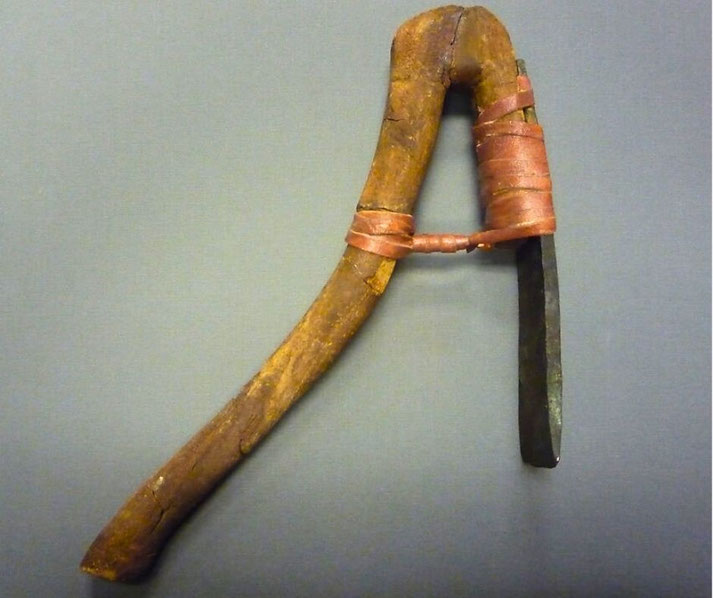
Quarry workers cut limestone and softer stones using copper chisels and stone hammers.
Wooden wedges, soaked in water so the expanding wood would split the rock along natural fractures, offered another essential technique.
For harder stones such as granite, they used dolerite pounders: heavy balls of igneous rock that could break down granite through repeated striking.
Archaeologist Mark Lehner has calculated that a team of 1,212 quarry workers, using these tools in rotation over twenty-three years, could have produced all 2.3 million blocks required for the Great Pyramid of Khufu.
Importantly, the copper tools used by Old Kingdom builders were more sophisticated than popular accounts suggest.
Research published by the Czech Institute of Egyptology has demonstrated that pyramid-era Egyptians did not use pure copper, as many sources still claim.
Instead, they used arsenical copper, an alloy typical of the Early Bronze Age across the ancient Near East.
Workers hardened their tools through a process of annealing and hammering, which gave copper chisels and saws enough durability to cut through soft stone over prolonged work periods.
Transportation posed an equally significant challenge, and the Egyptians addressed it through the use of water and organised labour.
Workers placed limestone blocks on wooden sledges and poured water in front of them to reduce friction on the sand.
Teams then hauled these sledges along purpose-built ramps made of earth and rubble.
Archaeological evidence from a quarry at Hatnub in Egypt’s Eastern Desert, excavated by a joint French and British team, uncovered a ramp system dating back 4,500 years.
The system used wooden posts and ropes to allow workers to pull alabaster blocks up slopes with gradients of 20 per cent or steeper.
Granite was transported from quarries at Aswan, over 800 kilometres to the south, by loading the blocks onto boats and shipping them down the Nile during the annual flood season.
The diary of Merer and what archaeology tells us
In 2013, French Egyptologist Pierre Tallet made one of the most important documentary discoveries in modern Egyptology.
At Wadi al-Jarf, a Red Sea harbour site about 120 kilometres south of Suez, Tallet unearthed a collection of thirty papyri dating to approximately 2560 BCE.
Among them was the diary of an inspector named Merer, who led a team of around 200 workers during the 26th year of Pharaoh Khufu’s reign.
Merer’s logbook recorded the daily transport of limestone blocks from the quarries at Tura to the construction site at Giza, approximately 15 to 20 kilometres away.
The documents described delivery schedules and cargo loads in detail, along with the provisioning of workers with food and beer, all laid out in a format resembling a modern spreadsheet.
As the oldest known papyri in existence, these documents provide direct, first-hand evidence of the logistics behind pyramid construction.
Alongside the papyri, excavations at Giza by Lehner and Egyptian archaeologist Zahi Hawass uncovered an entire workers’ village, complete with bakeries and workshops for daily living.
The workers were not slaves, as the Greek historian Herodotus had suggested centuries later.
They were skilled labourers who received regular rations of bread and beer, along with premium cuts of meat, and who were given proper burials near the pyramid site when they died.
Why these myths persist and why they matter
One of the most troubling aspects of the “lost technology” idea is its underlying assumption: that certain ancient peoples were incapable of constructing their own monuments.
Scholars such as archaeologist Kenneth Feder have noted that proponents of alien theories almost exclusively target non-European civilisations.
Von Däniken questioned the ability of Egyptians and the Maya to build their monuments, yet he never questioned how the ancient Greeks constructed the Parthenon or how the Romans built the Colosseum.
As medieval historian Chris Reidel has pointed out, the ancient aliens theory discredits non-white civilisations by suggesting they needed help from outside forces.
In reality, what has been “lost” is not a mysterious advanced technology, but rather specific craft techniques that disappeared over centuries of political upheaval and foreign invasion.
Egyptian artisans possessed extraordinary skills in stone-cutting and architectural engineering, along with sophisticated knowledge of papyrus manufacture and faience production.
Some of their specific methods, such as certain stone-polishing techniques and the exact formulation of their mortars, have not yet been fully replicated by modern researchers.
Gaps in our understanding do not indicate the presence of alien intervention or secret machines.
They simply mean that certain practical skills, passed down through generations of trained craftspeople, were lost when the institutions that sustained them eventually declined.