
The forgotten female pharaohs of ancient Egypt
Across more than three millennia of royal rule, ancient Egypt crowned somewhere between 170 and 200 pharaohs, but only a handful were women.
Often, the rise of a female pharaoh indicated a break in dynastic succession or the absence of a suitable male heir. At such times, royal women used their connections to temple institutions, their roles as mothers or daughters of kings, or their influence within court politics to assert control.
Later scribes wanted to normalise the royal line and downplayed or omitted these rulers from king-lists, and their successors gave the credit for their monuments to other kings or removed their images entirely.
Merneith: The early queen who shared power
During the First Dynasty, Merneith rose to importance as the probable regent for her son Den, who ascended the throne as a child around 2950 BCE.
From excavated tombs at Abydos and from objects that scholars have attributed to the early dynastic period, her name appears in official records, and her burial at Umm el-Qa’ab, specifically Tomb Y, closely resembled those of confirmed kings.
Her tomb included boat pits and additional graves, both of which connected her with elite funerary customs of early statehood.
For example, archaeologists uncovered seal impressions that included her name in a royal serekh, although without the falcon of Horus that typically identified full kingship.
That omission suggested that she did not reign with the same religious and political support granted to her male predecessors, but the size and design of her tomb, along with the sacrificial burials within it, indicate she held more than symbolic power.
Likely, her regency kept the kingdom stable until Den could rule independently.
Her name also appeared on objects found in Den's tomb.
However, her rule was not fully accepted in later king-lists, and it showed that royal women could, in certain circumstances, assume the duties of kingship when necessary.
Sobekneferu: The first to adopt the full titulary
At the end of the Middle Kingdom, Sobekneferu took the throne after the death of her half-brother Amenemhat IV, who had left no male heir.
She ruled from approximately 1806 to 1802 BCE, and some timelines of Egyptian history have placed her coming to the throne slightly earlier.
She is the first woman confirmed to have adopted the full five-part titulary of a pharaoh.
Her names appeared on seals and scarabs, together with inscriptions from temple sites and government centres, which established her reign as legitimate, if short-lived.
Importantly, Sobekneferu aligned herself with the crocodile god Sobek, especially in the Fayum region, where her father, Amenemhat III, had built extensive irrigation projects.
That religious association offered religious justification for her rule and helped her claim continuity with the previous king.
On statues and reliefs, she sometimes appeared in male clothing, and she wore the nemes headdress or uraeus, but her face retained feminine features.
That blending of masculine regalia with female form allowed her to fulfil royal expectations without discarding her identity.
A statue fragment that bears her cartouche is now held in Berlin (14486) and confirms her use of pharaonic titulary.
Scholars have also associated the unfinished South Mazghuna pyramid with her reign, based on the style of its design, and no convincing burial evidence has been found inside it.
Over time, her reign became a model for how female rulers might assume full royal authority under unusual situations.
Although the 13th Dynasty began in political trouble after her death, the survival of her titulary and imagery suggests that her rule achieved a recognised, if politically fragile, form of kingship.
Hatshepsut: The woman who transformed kingship
When Thutmose II died in the 18th Dynasty, his son Thutmose III was too young to govern, and Hatshepsut was his stepmother and aunt and initially ruled as regent.
Over the next several years, she had gradually expanded her role and, by the seventh year of her regency, declared herself pharaoh.
She began using the full royal titulary, and her name appeared on temple walls and public inscriptions carved on major monuments alongside male rulers.
To strengthen her claim, she commissioned reliefs at her mortuary temple at Deir el-Bahri, where she narrated her sacred birth from the god Amun.
That narrative, repeated in temple art and texts, gave her rule a strong religious basis.
She also initiated what later Egyptians regarded as Egypt’s celebrated expedition to the Land of Punt, which brought back incense, myrrh trees, exotic goods, and animals, all of which appeared in detailed temple scenes within the Punt Portico at Deir el-Bahri.
While the transportation and survival of living myrrh trees are still uncertain, the artistic depictions confirm the ceremonial and economic importance of the expedition.
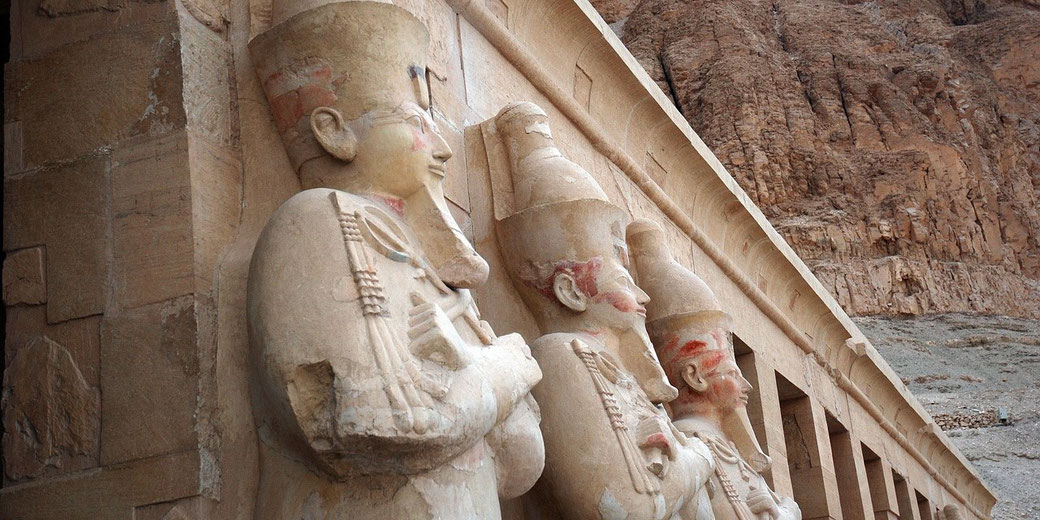
Osiride statues of Hatshepsut lined the temple’s upper colonnades, and they depicted her as both godlike and royal.
The scale of these projects, alongside the use of royal titulary and religious imagery, confirmed for later observers that she had been more than a caretaker and that she had become a full ruler in her own right.
Later, Thutmose III sought to erase her from history. He had ordered the removal of her cartouches, the defacement of her statues, and the reattribution of her buildings.
However, fragments that were recovered from Deir el-Bahri, Karnak, and elsewhere have allowed scholars to reconstruct much of her reign.
Her architecture and religious reforms, together with her deliberate use of royal symbolism, show that she adopted kingship in a time of need and then redefined its boundaries.
Twosret: The last queen of the 19th dynasty
After the short reign of Siptah, Twosret claimed the throne during a time of political trouble at the close of the 19th Dynasty.
As Great Royal Wife of Seti II and stepmother to Siptah, she possessed both royal lineage and court influence, which she used to secure power.
She ruled under her own name for at least two years, as evidenced by inscriptions and tomb reliefs, along with scarabs that carried her royal titles.
If her regency during Siptah's minority is counted, her time in authority may have lasted up to seven years, and the exact duration is still uncertain.
Her tomb was KV14 in the Valley of the Kings and featured extensive decorations, and she appeared in the company of deities typically shown with kings.
In temple additions and administrative inscriptions, she used male titles and images in a way that followed the established tradition of earlier female pharaohs.
However, her reign ended with the rise of Setnakhte, the founder of the 20th Dynasty, who declared that her period of rule had not been valid.
He later usurped and enlarged her tomb for his own burial.
As a result, later king-lists excluded her entirely, and some scribes reassigned her regnal years to other male figures.
Still, her architectural works and the survival of her cartouches confirm her reign, and her sudden fall and the removal of her memory after her death show how uncertain female rule could be during periods when succession crises often led to violent power shifts.
Other women who held power through alternative paths
Throughout Egypt’s later dynasties, royal women often held considerable influence without ever taking the formal title of pharaoh.
During the 25th and 26th Dynasties, the office of God’s Wife of Amun became a powerful position held by royal daughters who exercised control over temples and royal wealth, as well as key priesthoods.
This role arguably became most powerful during the Third Intermediate Period and the Late Period.
Women such as Shepenwepet II, Amenirdis I, and Nitocris I held administrative authority, travelled on official business, and appeared in inscriptions that described them as figures of political importance.
For instance, Nitocris I received an adoption stela that officially confirmed her succession into the role, and the text outlined her responsibilities and privileges, alongside a detailed list of sacred duties.
That stela was discovered in the Karnak temple complex and is now housed in the Open-Air Museum, and it showed that she controlled both religious ceremonies and temple income.
While not pharaoh in title, she managed resources and coordinated rituals that showed that she held real power.
Similarly, temple reliefs from Karnak and Medinet Habu portray these women as they make offerings and issue commands alongside high priests and royal scribes.
Shepenwepet II also commissioned her own burial chapel at Medinet Habu, which probably made her importance even clearer.
Earlier, the mysterious Nitocris of the 6th Dynasty appeared in Herodotus’ Histories, where he described her as a queen who avenged her brother’s death when she drowned his assassins during a banquet.
However, her name does not appear in contemporary Egyptian records, and no archaeological evidence confirms her reign.
Manetho wrote in the 3rd century BCE and included her in his king-list as the last ruler of the 6th Dynasty.
Whether myth or a later story that people made up, the fact that people kept telling her story suggests that female power had been a repeated, if uncomfortable, theme in Egyptian royal memory.